
// Reconstitution & Draw — For Research Use Only
Mixing & Measuring,
Made Simple.
New to reconstitution? Most of the confusion comes down to one idea: the powder and the liquid are measured in different ways. Learn it once here — then let the calculator do the math.
// Start Here — The One Idea That Unlocks Everything
Solid vs. Liquid
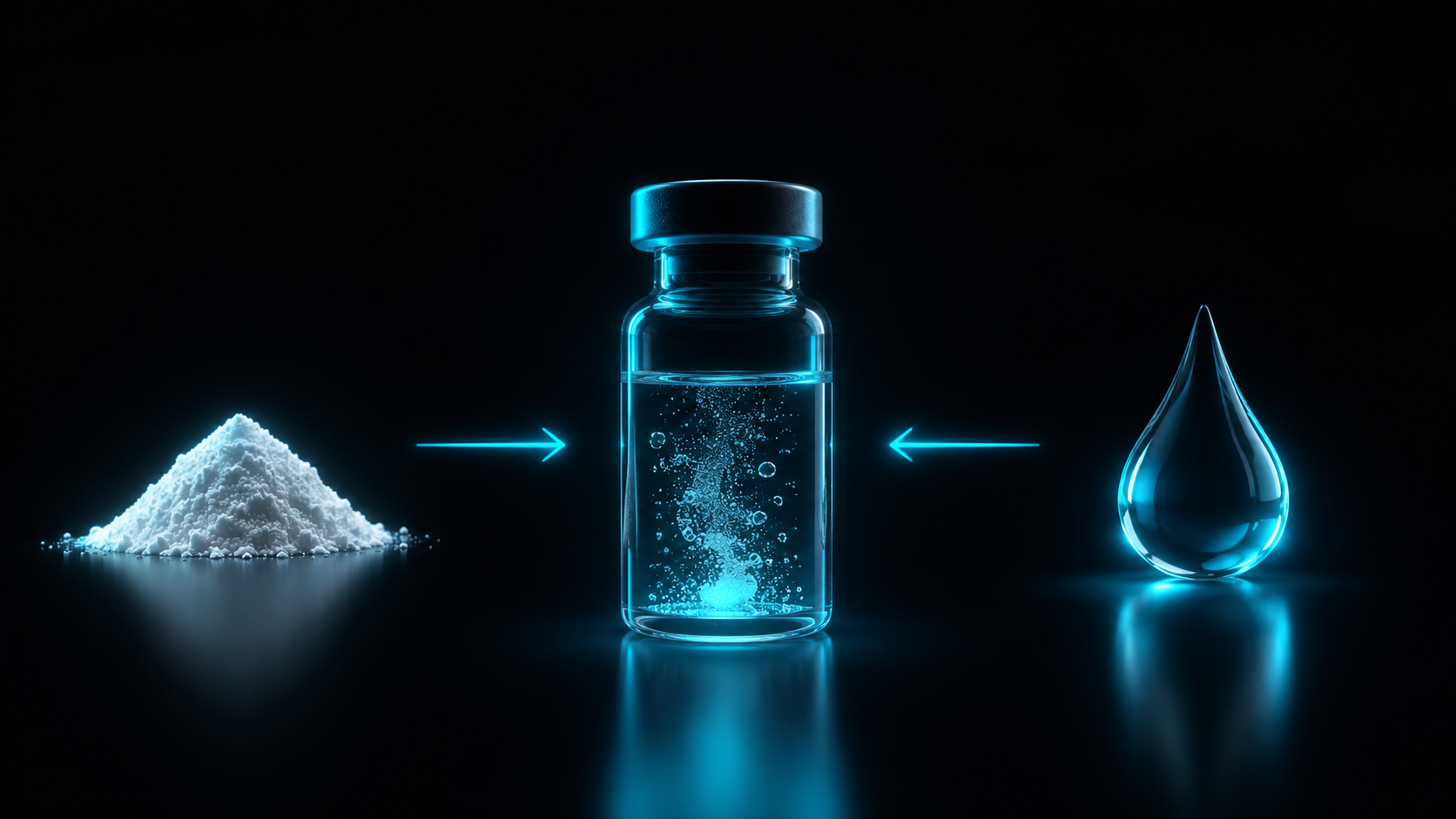
You start with a dry powder (the peptide) and add a liquid (typically bacteriostatic water). Everything else on this page is just figuring out how much peptide ends up in each pull of the syringe. Get these two units straight and the rest falls into place:
How much peptide you have — a weight. 1 mg = 1000 mcg. Once it dissolves you can’t see it, but it’s still in there.
How much liquid you add (most commonly bacteriostatic water) — a volume. The syringe measures this liquid, not the peptide itself.
// Step 1
Reconstitute — How Much Water?
Tell us what’s in your vial and how much liquid you’re adding. We’ll give you the concentrationHow much peptide is in each millilitre of liquid, written as mg/mL. It’s the bridge between the solid (mg) and the liquid (mL). — the number Step 2 needs.
The amount printed on the vial (the dry powder).
More water = weaker mix (lower concentration). Less water = stronger. Bacteriostatic water is the most commonly used reconstitution solvent; the right choice depends on the compound and protocol.
A 3 mL vial physically holds 3 mL — you can’t add more than it fits.
There’s no single “right” amount — it just changes how strong your mix is. Most researchers add 2 mL or 3 mL for a few practical reasons: it’s an easy round number to measure, it fits comfortably inside a standard 3 mL vial, and it keeps the concentration math simple. More water spreads the same peptide thinner (lower mg/mL, so you draw a bit more liquid); less water makes it stronger (higher mg/mL, so you draw less). The amount of peptide never changes — only how much liquid it’s spread through.
// Step 2
Draw — How Far Do I Pull?
Enter the working amountThe amount of peptide you want to draw into the syringe for your research protocol, measured in mcg or mg. you want and pick your syringe. The syringe below moves to show you the exact line to pull to.
Tip: 1000 mcg = 1 mg. Double-check you picked the right unit — it’s a common mix-up.
All insulin syringes use the same scale: 100 units = 1 mL. Bigger sizes just hold more.
You don’t need the calculator once you see the pattern — it’s two divisions and a glance at the syringe:
- Find your concentration. Peptide (mg) ÷ water (mL). 5 mg ÷ 2 mL = 2.5 mg/mL
- Find the liquid you need. Working amount (in mg) ÷ concentration. 1 mg ÷ 2.5 mg/mL = 0.4 mL
- Read it on the syringe. Multiply mL × 100 for units. 0.4 mL × 100 = the 40 line
Working in mcg? Divide by 1000 first to get mg (e.g. 500 mcg = 0.5 mg), then follow the same steps.
The numbers on the syringe do not tell you how much peptide you have — they only measure liquid. How much peptide sits at each line depends entirely on your concentration from Step 1. Change the water you add, and the same “40 line” holds a different amount of peptide.
// Plain-English Glossary
The Terms, Decoded
For research use only · Not for human or veterinary consumption
This tool is provided for laboratory reference. These statements have not been evaluated by the FDA.
A research peptide ships as a dry powder. Before it can be measured or studied in solution, it has to be turned back into a liquid — that step is called reconstitution. The calculator above does the arithmetic that comes with it: how concentrated the vial becomes once you add liquid, and what line on the syringe a given working amount lands on. This guide explains the reasoning behind those numbers so the tool isn’t a black box.
Everything here is written for handling research compounds in a laboratory context. It is reference material about volumes, concentrations, and syringe markings — not guidance for use in or on any person or animal. Research peptides sold for research are labeled for research use only, and that boundary runs through this entire page.
The one idea that makes reconstitution click
Almost every reconstitution mistake traces back to mixing up three things: the mass of peptide in the vial, the volume of liquid you add, and the concentration that results. They are not the same number, and the calculator’s whole job is to keep them straight.
- Mass is what’s printed on the vial — for example 10 mg of lyophilized (freeze-dried) powder. It does not change when you add liquid. You still have 10 mg; it’s just dissolved now.
- Volume is the amount of liquid you put in. This is your choice, and it’s the lever that sets everything downstream.
- Concentration is mass divided by volume, written in mg/mL. It tells you how much peptide sits in each milliliter of finished solution.
The relationship is simple division: concentration = mass ÷ volume. Put 10 mg into 1 mL and you get 10 mg/mL. Put the same 10 mg into 2 mL and you get 5 mg/mL — same powder, half the strength per milliliter, because you spread it across twice the liquid. Neither is “more” or “less” peptide. It’s the same mass at a different dilution.
How to use the calculator, step by step
The tool is built in two stages because reconstitution itself happens in two stages.
Step 1 — Reconstitute
Enter the labeled mass of the vial (the milligram figure on the COA and label) and the volume of liquid you intend to add. The calculator returns the resulting concentration in mg/mL and mcg/mL. That single number — the concentration — is the foundation for everything in Step 2. Change the volume and watch the concentration move; this is the clearest way to see the mass-volume-concentration relationship rather than just read about it.
Step 2 — Draw
Now you tell the calculator a working amount — the quantity of peptide you want to pull out of the vial for a given measurement — and it converts that into a draw: the exact line you’d pull the plunger back to on your syringe. Use the mcg/mg toggle so your working amount and your label units agree, and pick the syringe size (30, 50, or 100 units) that matches the barrel you’re reading. The live syringe diagram fills to show where that line falls, and a warning appears if a draw would exceed the barrel’s capacity.
Reading an insulin syringe: units vs. milliliters
This is the single most common point of confusion, and it has nothing to do with peptides — it’s about how the syringe is printed. A standard insulin syringe is a U-100 syringe, which means it’s graduated for 100 units per milliliter. So the markings you see are units, not milligrams and not micrograms.
- On a 100-unit (1 mL) syringe, the 100 line is 1 mL, the 50 line is 0.5 mL, the 10 line is 0.1 mL.
- A 50-unit syringe holds 0.5 mL at its top line; a 30-unit syringe holds 0.3 mL.
- “Units” on the barrel are a volume scale, not a measure of how much peptide you’ve drawn. Two different vials at two different concentrations can both read “20 units” and contain completely different masses of peptide.
That last point is why the calculator exists. It takes your concentration (from Step 1) and your working amount and tells you which unit line corresponds to the right volume — so you’re reading the barrel correctly instead of guessing. The math by hand is draw (mL) = working amount ÷ concentration, then convert mL to units by multiplying by 100 for a U-100 barrel.
Choosing a reconstitution solvent
The liquid you dissolve the powder in is the solvent (or diluent). For research peptides, the most commonly referenced reconstitution solvent is bacteriostatic water. According to its USP labeling, Bacteriostatic Water for Injection is sterile, nonpyrogenic water containing 0.9% (9 mg/mL) — sometimes 1.1% (11 mg/mL) — benzyl alcohol as a preservative, supplied in a multiple-dose container so repeated withdrawals can be made.[1] The benzyl alcohol is what makes it “bacteriostatic”: it inhibits microbial growth, which is the practical reason it’s favored over plain sterile water when a vial will be accessed more than once over time.
Other diluents exist — plain sterile water, saline, and various buffers among them — and the right choice depends on the specific compound’s solubility and stability and on the protocol it’s being prepared for. Some peptides dissolve readily in water; others call for a buffered or slightly acidic environment. That compound-by-compound chemistry is a research design question, not something a volume calculator decides, so this tool stays agnostic about which solvent you use and simply does the math once you’ve added it.
Storage, handling, and freeze–thaw
Reconstitution math is only useful if the material in the vial actually matches its label by the time you measure it. A few handling realities shape that:
- Before reconstitution, lyophilized peptide is at its most stable. Freeze-drying removes the water that drives most degradation, which is why these compounds ship as powder rather than solution.
- After reconstitution, the clock starts. A dissolved peptide is less stable than its dry form, and how long it holds depends on the compound, the solvent, temperature, and light exposure.
- Freeze–thaw cycles are hard on peptides in solution. Repeatedly freezing and thawing the same vial can degrade the material; minimizing cycles is general good practice in peptide handling.
- Labeling your reconstituted vial — compound, concentration, date, batch — prevents the most avoidable error of all: measuring against a concentration you only think the vial has.
Why purity changes your math
Here is the part most calculators quietly skip. Every number this tool produces assumes the vial contains the full labeled mass of actual peptide. If a vial is labeled 10 mg but the powder is only 80% peptide, your real concentration isn’t 10 mg/mL after a 1 mL reconstitution — it’s 8. Every draw you calculate off that vial is then off by the same 20%, no matter how careful your arithmetic is.
That’s why purity isn’t a marketing line for us — it’s the input the entire calculation rests on. A batch-specific Certificate of Analysis tells you what’s actually in the vial, and a high, verified purity is what makes the label honest enough to calculate against. It’s the reason behind our standard: 99%+ or nothing. The cleaner the material and the more transparent the testing, the more the number on the label means what it says — and the more your reconstitution math can be trusted.
This also reflects what these compounds are, regulatorily. Research peptides are sold for research use only; the FDA frames properly labeled research-use products as materials in the laboratory research phase, distinct from anything cleared for diagnostic or therapeutic use, and it has been explicit that a label alone doesn’t change how a product is actually represented and used.[2] Honest labeling and verifiable testing are how that line stays clean.
What this calculator does not do
Being clear about the limits is part of using the tool correctly:
- It does not recommend a working amount, a frequency, or a protocol of any kind.
- It does not verify what’s in your vial — that’s the COA’s job, not a calculator’s.
- It does not account for impurity, degradation, or measurement error; it assumes a clean, accurately labeled vial.
- It does not apply to any use in or on a living subject. It is a volume-and-units reference for research handling only.
Common mistakes researchers make
- Confusing units with milligrams. The syringe is marked in units (volume), not in peptide mass. Always convert through concentration.
- Forgetting that volume sets concentration. Adding “a bit more” bac water changes every subsequent draw. Pick a volume deliberately and write it down.
- Mixing mcg and mg. One milligram is 1,000 micrograms. A units mismatch here is a 1,000× error. Keep the calculator toggle aligned with your label.
- Calculating against the labeled mass instead of the real one. A low-purity vial breaks the math before you start — which loops straight back to the COA.
- Re-freezing the working vial repeatedly. Each cycle is a chance to lose material the calculator can’t see.
Frequently asked questions
What does it mean to reconstitute a research peptide?
Reconstitution is dissolving a freeze-dried (lyophilized) peptide powder back into a liquid by adding a solvent such as bacteriostatic water. The mass of peptide stays the same; you’re putting it into solution so it can be measured by volume. The resulting strength per milliliter is its concentration.
What’s the difference between mcg and mg?
A milligram (mg) is 1,000 micrograms (mcg). They’re both units of mass, just at different scales. Vials are usually labeled in mg, while working amounts are often discussed in mcg, so the calculator includes a toggle to keep the two from getting crossed — a mismatch here is a 1,000× error.
What is bacteriostatic water?
Bacteriostatic Water for Injection, USP is sterile, nonpyrogenic water that contains 0.9% (9 mg/mL) — sometimes 1.1% — benzyl alcohol as a preservative, supplied in a multiple-dose container so repeated withdrawals can be made.[1] The benzyl alcohol inhibits microbial growth, which is why it’s commonly referenced for vials that will be accessed more than once.
How much liquid should I add to the vial?
There isn’t one “correct” amount — the volume you add simply sets the concentration. More solvent makes a more dilute solution and a larger draw for the same working amount; less solvent makes a more concentrated solution and a smaller draw. The calculator shows you the concentration any volume produces so you can see the trade-off. Choosing a target for a specific protocol is outside the scope of this tool.
What is concentration (mg/mL) and why does it matter?
Concentration is mass divided by volume — how much peptide sits in each milliliter of finished solution. It’s the bridge between the powder in the vial and the line on the syringe. Every draw calculation runs through it, which is why Step 1 of the calculator establishes it before Step 2 uses it.
How do I read the units on an insulin syringe?
A standard insulin syringe is U-100, meaning 100 units per milliliter. So the 100 line is 1 mL, the 50 line is 0.5 mL, the 10 line is 0.1 mL. The units are a volume scale, not a measure of peptide mass — you convert your working amount to a volume through concentration first, then read that volume on the barrel.
Does it matter which syringe size I select (30, 50, or 100 units)?
Yes — the size sets the barrel’s capacity and the spacing of the lines you’re reading. Selecting the size that matches your actual syringe makes the diagram and the unit line accurate, and lets the tool warn you if a draw would exceed the barrel.
Why does purity affect the numbers?
Every calculation assumes the vial holds the full labeled mass of peptide. If purity is lower than labeled, the real concentration is lower too, and every draw is off by the same margin. That’s why a batch-specific COA and a high verified purity matter — the math is only as honest as the material it’s based on.
Can this calculator tell me how much to use?
No. It’s a volume-and-units tool for research handling. It converts a working amount you already have into the correct syringe line; it does not recommend amounts, frequencies, or protocols, and it doesn’t apply to use in or on any living subject.
What do “working amount” and “draw” mean here?
The working amount is the quantity of peptide you want to pull from the vial for a given measurement. The draw is the volume that contains it — the line you pull the plunger back to. The calculator converts between the two using the vial’s concentration.
Why do you test every batch to 99%+?
Because the label is only meaningful if the material matches it. We test each batch for purity along with heavy metals, sterility, and endotoxin, and tie the results to the vial so the number you calculate against is verifiable. The standard is simple: 99%+ or nothing.
Is this calculator a substitute for a COA?
No. A calculator does arithmetic; it can’t tell you what’s actually in a vial. Only batch-specific testing — a Certificate of Analysis — can do that. The calculator assumes a clean, accurately labeled vial, and the COA is what makes that assumption safe to rely on.
Research use only. All information on this page is provided for educational and research reference purposes only. Research compounds are not for human or veterinary use, ingestion, or any diagnostic or therapeutic application. Nothing here is medical advice or a protocol of any kind.
- [1] Bacteriostatic Water for Injection, USP — prescribing information (composition, preservative, multiple-dose use). Pfizer Medical / U.S. National Library of Medicine, DailyMed. https://www.pfizermedical.com/bacteriostatic-water/description
- [2] U.S. Food & Drug Administration. Distribution of In Vitro Diagnostic Products Labeled for Research Use Only or Investigational Use Only (Guidance, 2013) — framing of properly labeled research-use products. https://www.fda.gov/regulatory-information/search-fda-guidance-documents/distribution-in-vitro-diagnostic-products-labeled-research-use-only-or-investigational-use-only