
Where Do Research Peptides Actually Come From?
// Research Education · Supply Chain · Peptide Synthesis · Titanborn Research
Most researchers can tell you what BPC-157 does. Very few can tell you where it comes from, how it is made, or what happens between a chemical synthesis facility and the vial that arrives at their door. That gap matters more than most people realize.
The Starting Point — Amino Acids
Every research peptide begins with amino acids — the same building blocks found in all living organisms. The amino acids used in peptide synthesis are manufactured to high purity specifications, typically sourced from chemical manufacturers in China, India, Europe, and the United States. The quality of the starting amino acids directly affects the quality of the final peptide. This is the first point in the supply chain where variation enters.
For a peptide like BPC-157 — a 15-amino acid sequence — the synthesis process requires 15 individual amino acid building blocks, each added sequentially in the correct order. A single error in the sequence, a single impurity in a starting material, or a single deviation in the synthesis protocol produces a different compound entirely.
Solid Phase Peptide Synthesis — How Peptides Are Actually Made
The dominant manufacturing method for research peptides is Solid Phase Peptide Synthesis, or SPPS. Developed by Nobel Prize winner Robert Bruce Merrifield in the 1960s, SPPS remains the gold standard for producing synthetic peptides at research and commercial scale.
The process works by anchoring the first amino acid to a solid resin bead, then adding each subsequent amino acid one at a time in a carefully controlled chemical reaction. Between each addition, the growing chain is washed, deprotected, and prepared for the next coupling step. When the full sequence is assembled, the peptide is cleaved from the resin and purified.
The sophistication of the equipment used for SPPS — and the quality controls applied at each step — varies enormously between manufacturers. A state-of-the-art automated synthesizer in a GMP-compliant facility operates very differently from a manual synthesis in an uncontrolled environment. Both can produce a compound with the right sequence. Only one produces a compound with consistent, verifiable purity.
// Key Point
The synthesis method alone does not determine peptide quality. The quality controls, equipment calibration, reagent purity, and operator expertise at each step in the process are what separate research-grade peptides from everything else.
Purification — Where Most of the Variation Happens
Raw peptide output from SPPS is not research-grade material. The crude synthesis product contains the target peptide along with deletion sequences, truncated chains, protecting group remnants, and other synthesis byproducts. Purification is what separates the target compound from everything else.
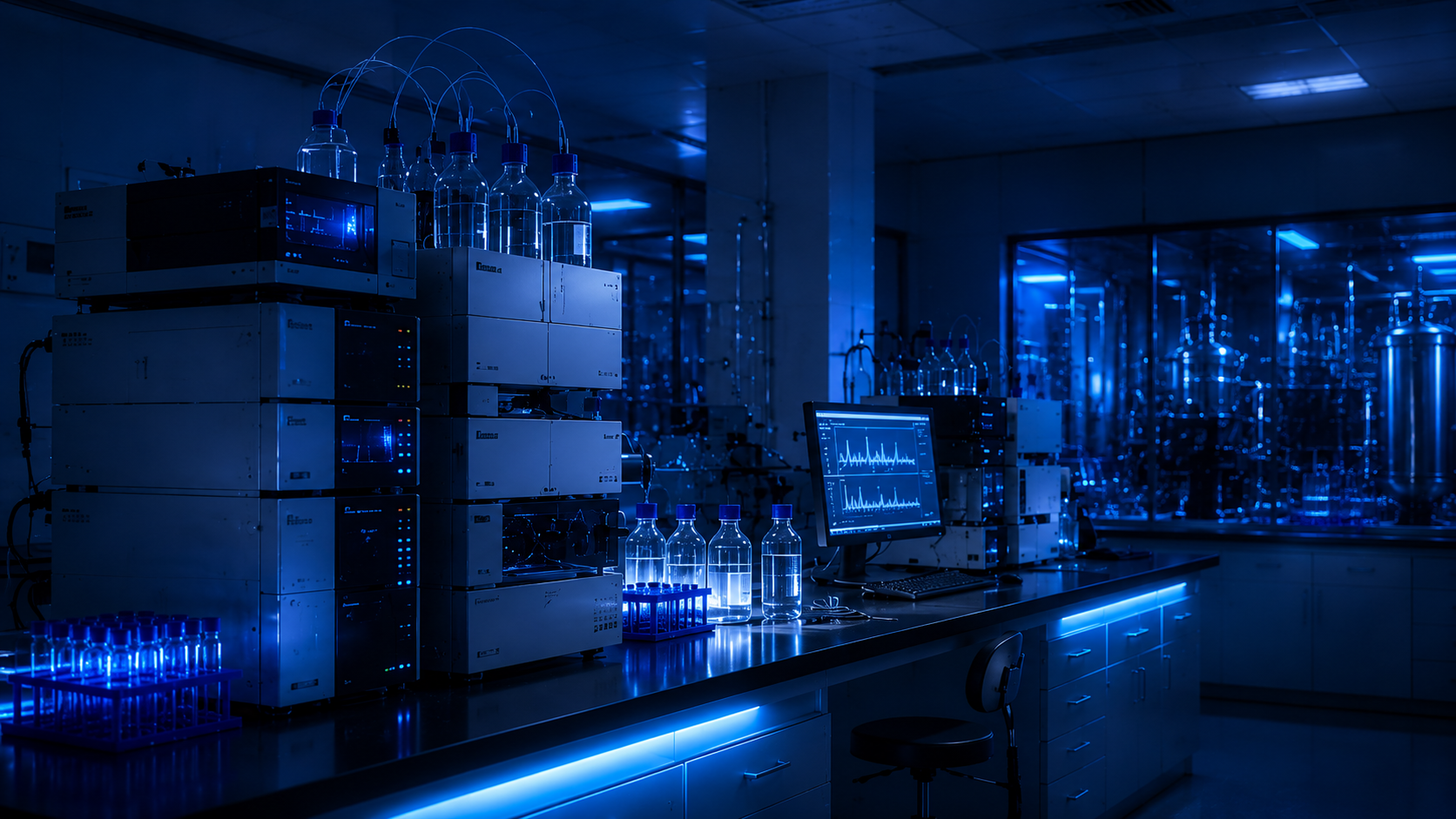
High-Performance Liquid Chromatography — HPLC — is the primary purification method for research peptides. The crude peptide mixture is passed through a chromatography column under pressure, separating compounds based on their chemical properties. Multiple purification runs may be required to achieve target purity levels.
This is the step that determines whether a peptide achieves 95% purity, 98% purity, or 99%+ purity. The difference between those numbers is not minor — it represents the percentage of the material in the vial that is actually the compound you ordered. At 95% purity, 5% of the material in your vial is something else. At 99%+, that number drops to less than 1%.
At Titanborn Research, we enforce a strict 99%+ minimum purity threshold on every product we carry. That number comes from our independent third-party testing — not from the manufacturer’s own claims.
Lyophilization — Why Peptides Come as Powder
After purification, the peptide solution undergoes lyophilization — freeze-drying. The solution is frozen and then placed under vacuum, causing the water to sublimate directly from solid to vapor without passing through a liquid phase. The result is a dry, stable powder that can be stored for extended periods without degradation.
Lyophilized peptides are significantly more stable than liquid preparations. Properly lyophilized BPC-157, for example, can maintain stability for years when stored correctly at -20°C. The quality of the lyophilization process — the equipment used, the cycle parameters, and the final moisture content — affects both the stability and the appearance of the final product.
Where Most Research Peptides Are Manufactured
The majority of research peptides sold in the United States are synthesized in China or India, where peptide chemistry expertise, manufacturing infrastructure, and production costs are well established. This is not inherently a quality concern — some of the most sophisticated peptide synthesis facilities in the world operate in China, and many pharmaceutical-grade peptides used in FDA-approved drugs are manufactured there.
What matters is not where the peptide is made but what quality controls are applied during manufacturing and what independent verification is performed after the fact. A peptide synthesized in a Chinese GMP facility with full documentation and independent third-party testing is a fundamentally different product from one produced in an unverified facility with no independent quality confirmation.
The Supply Chain Between Manufacturer and Researcher
Between the synthesis facility and your research lab, a research peptide typically passes through several hands. The manufacturer produces and performs initial quality control. A distributor or vendor purchases in bulk, performs their own quality verification, repackages into individual vials, and sells to end users.
Each transition in this chain is a point where documentation integrity either holds or breaks down. A batch-specific Certificate of Analysis that traces back to a named, accredited independent laboratory maintains the integrity of that chain. A generic COA, a COA from the manufacturer’s own lab, or no COA at all represents a break in that chain that cannot be reconstructed after the fact.
How Titanborn Research Approaches the Supply Chain
Every batch of every compound we carry is independently tested by Vanguard Laboratory in Olympia, Washington — an ISO/IEC 17025:2017 accredited, A2LA certified U.S. laboratory — before it enters our inventory. Testing includes HPLC purity analysis, LC-MS identity confirmation, endotoxin testing, sterility, and heavy metals screening.
The Certificate of Analysis from Vanguard is batch-specific — it corresponds to the exact production run in the vials you receive. The QR code on every vial links directly to Vanguard’s hosted results. You are not taking our word for the purity of what you ordered. You are reading an independent laboratory’s result from their own hosted server.
That is what supply chain integrity looks like in practice. Not a claim on a product page — a verifiable result from an accredited laboratory with no financial relationship to the product being tested.
// Titanborn Standard
99%+ purity minimum. USA-based ISO 17025 accredited independent testing. Batch-specific COA. QR verified live results. Every order. 99%+ or Nothing.
This article is for educational and informational purposes only · All Titanborn Research products are for research use only · Not for human consumption · Not for veterinary use · titanbornresearch.com